Cat breed · France
Birman
Mèo Birman (mèo thiêng Miến Điện)

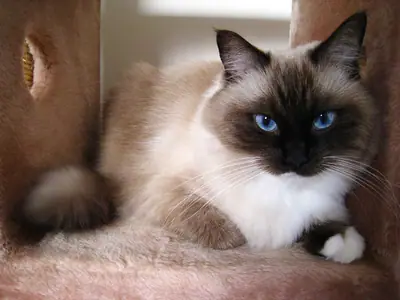
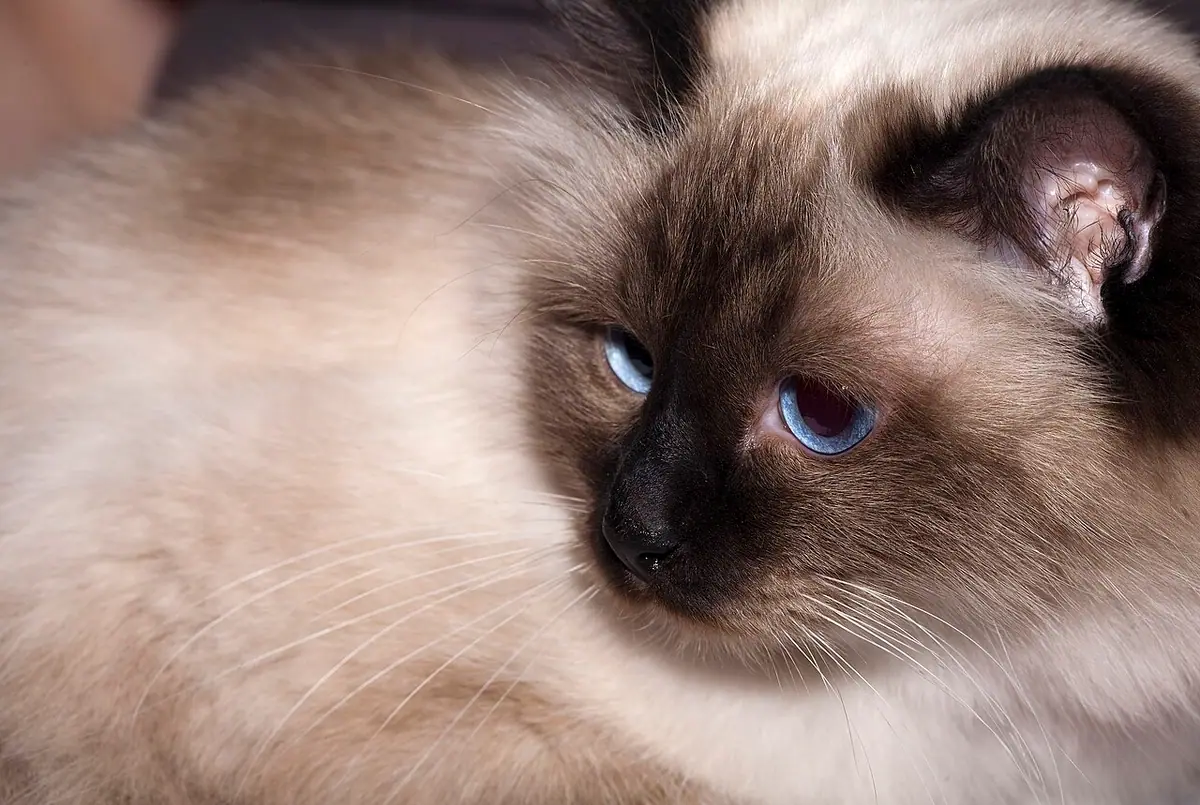
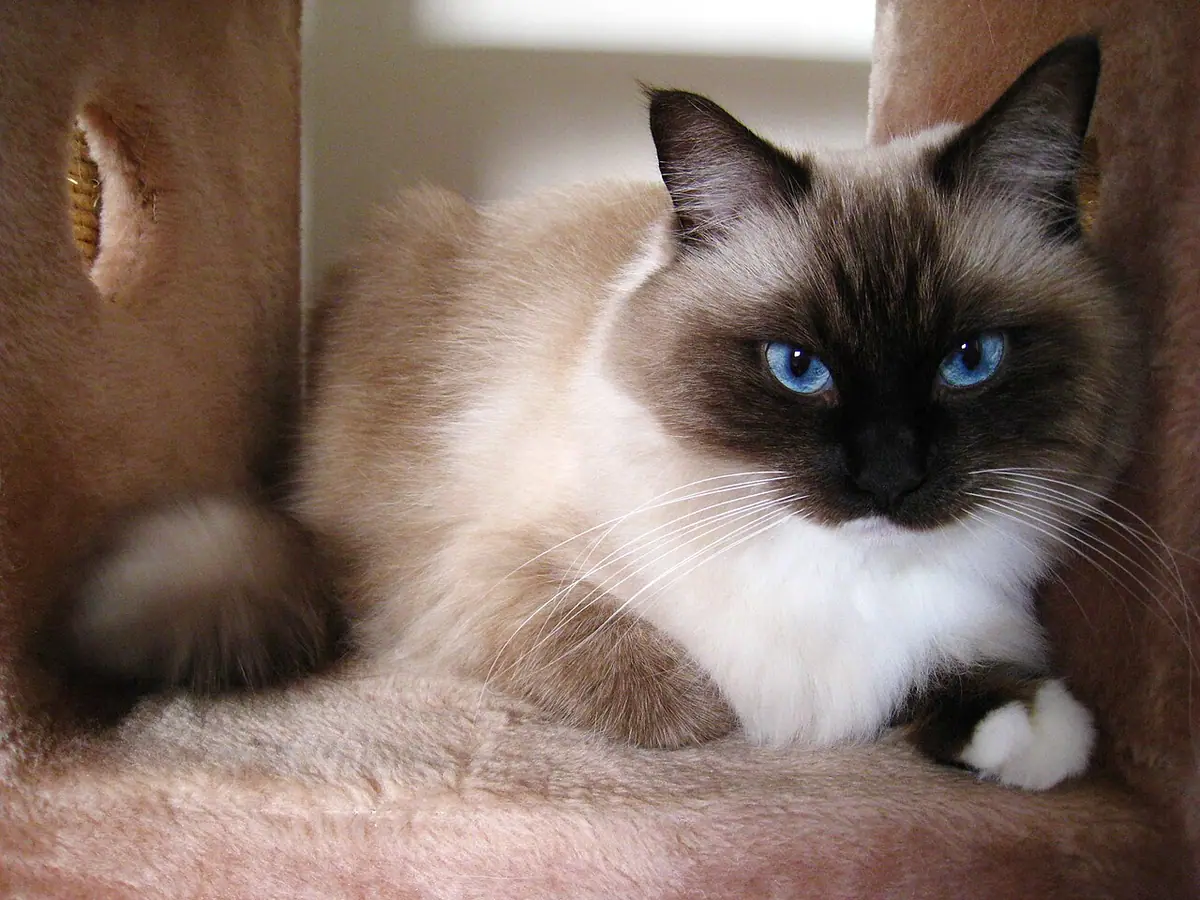
The Birman, the "Sacred Cat of Burma", is a long-haired Colorpoint: A pale body with darker face, ears, legs and tail, like a Siamese. All terms with deep blue eyes and four pure white feet [1]. Birmans are sweet, patient, even-tempered and devoted to human company [1]. Don't confuse it with the Burmese, a completely different shorthaired breed [5]. The Birman was one of FIFe (Fédération Internationale Féline): The International Feline Federation, an umbrella body of cat clubs, mostly in Europe. All terms 's founding breeds in 1949, as the "Sacred Birman" [2], and is recognised by CFA (Cat Fanciers' Association): The world's largest registry of pedigree cats, based in the US. It keeps pedigree records, writes breed standards and runs cat shows. All terms , TICA (The International Cat Association): An international cat registry based in the US and one of the largest. It often recognizes newer breeds before CFA does. All terms [8] and GCCF (Governing Council of the Cat Fancy): The UK's oldest pedigree cat registry (since 1910). All terms [9] too.
Contents (10 sections)
Quick facts
- Origin
- Burma (Myanmar), developed in France from about 1919
- Weight
- ~2.7–5.4 kg
- Lifespan
- ~12–16 years
- Coat
- long, silky
- Energy
- moderate
Details & sources
- Size
- Medium to large, long yet stocky [1]
- Weight
- Purina UK gives about 2.7–5.4 kg [10]
- Lifespan
- Purina UK estimates 12–16 years [10]; Median: The middle value: half the cats lived shorter than this, half lived longer. All terms 16.1 years but from only 12 cats [3]; life expectancy about 14.4 years in a 2024 UK study [4]
- Coat
- Long and silky, with no undercoat to tangle [1]
Traits (scale 1–5)
- Energy
- 3/5
- Shedding
- 2/5
- Grooming needs
- 2/5
- Good with kids
- 5/5
- Vocal
- 2/5
- Independence
- 1/5
Basis: Editorial estimate based on CFA (Cat Fanciers' Association): The world's largest registry of pedigree cats, based in the US. It keeps pedigree records, writes breed standards and runs cat shows. All terms 's description, not a measurement
Recognized by major cat registries
Cat registries keep pedigree records and set the standard for each breed. Tap an abbreviation to see what it means.
| CFA (Cat Fanciers' Association): The world's largest registry of pedigree cats, based in the US. It keeps pedigree records, writes breed standards and runs cat shows. All terms US | Yes |
|---|---|
| TICA (The International Cat Association): An international cat registry based in the US and one of the largest. It often recognizes newer breeds before CFA does. All terms international, US-based | Yes |
| FIFe (Fédération Internationale Féline): The International Feline Federation, an umbrella body of cat clubs, mostly in Europe. All terms Europe | Yes |
| GCCF (Governing Council of the Cat Fancy): The UK's oldest pedigree cat registry (since 1910). All terms UK | Yes |
History
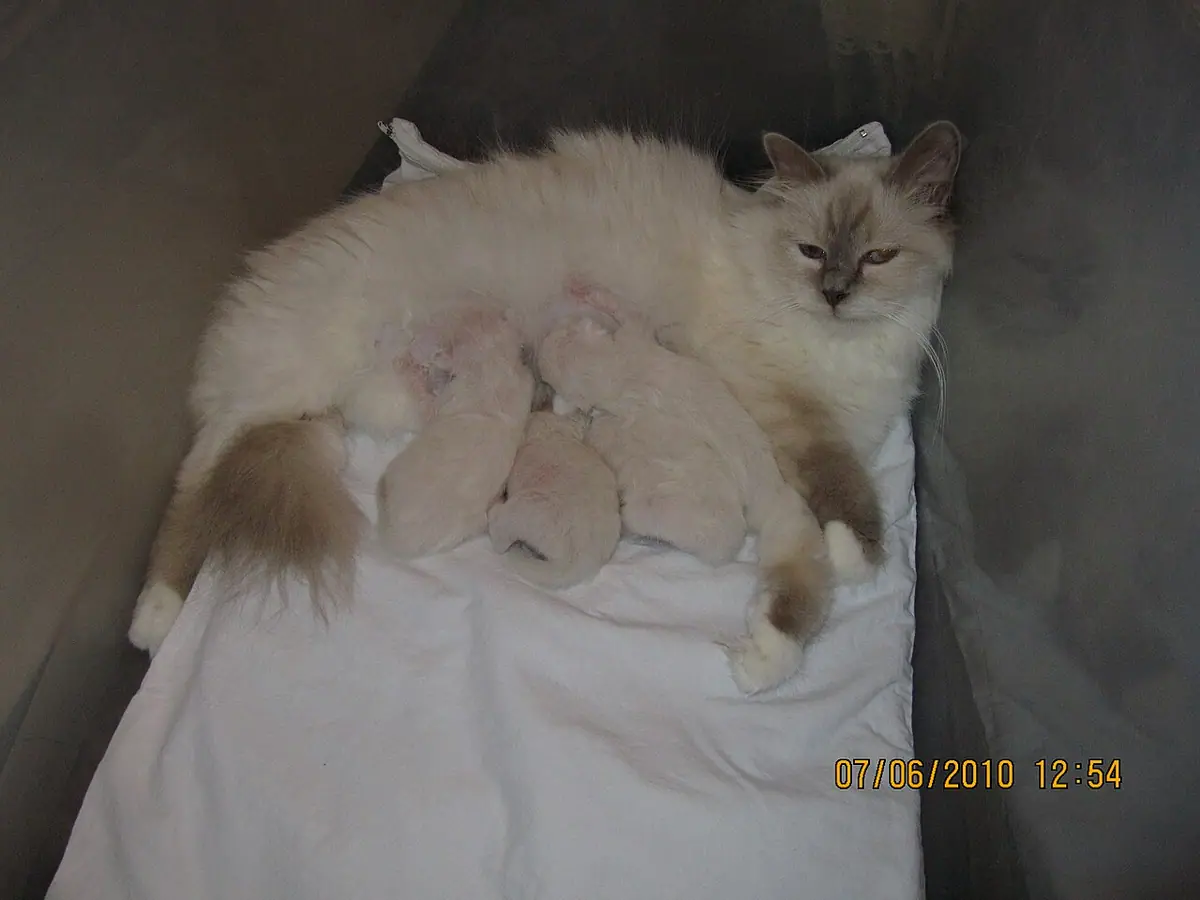
Folk tales abound about how the Birman got its markings, but its real history keeps everyone guessing [1]. What is known: around 1919 a breeding pair was shipped from Burma to France. The female arrived pregnant and became the foundation of the breed in France [1]. The name comes from "Birmanie", French for Burma [1]. After World War II only one breeding pair was left in Europe. French breeders rebuilt the breed by outcrossing to Persians and Siamese, and by the early 1950s pure Birman litters were being born again [1]. The breed reached the US in 1959 and CFA accepted it for registration in 1967 [1].
Appearance
- Body: medium to large, elongated and stocky, neither svelte nor Cobby: A short, compact, sturdy body with a broad chest and short legs. All terms [1].
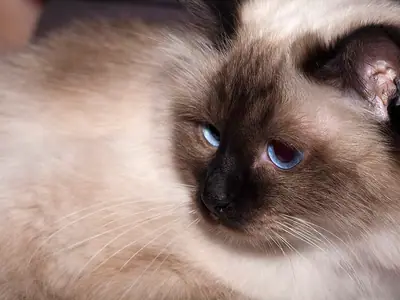
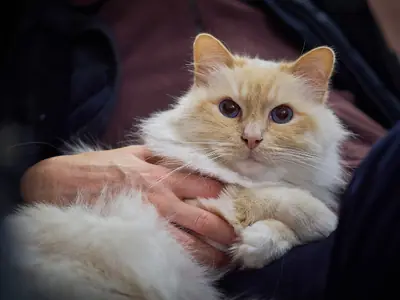
- Head: broad and rounded, with strong jaws and a medium-length Roman nose; almost-round blue eyes set well apart [1].
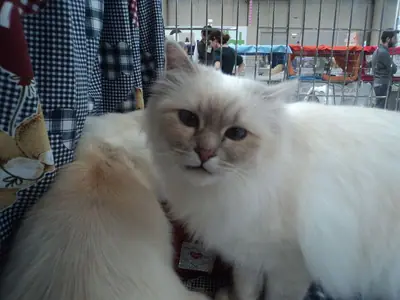
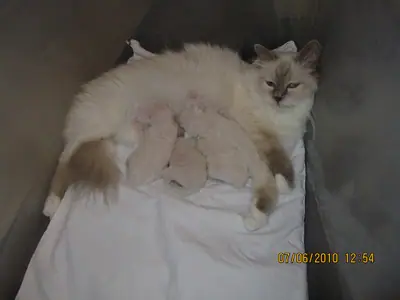
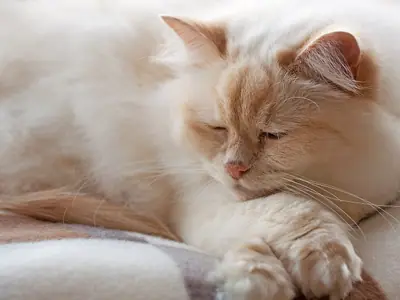
- Coat: long and silky; pale body with darker face, legs and tail, sometimes with a "golden mist" on the back [1].
- Feet: the bicolour gene gives white "gloves" on the front paws and "laces" on the back [1].
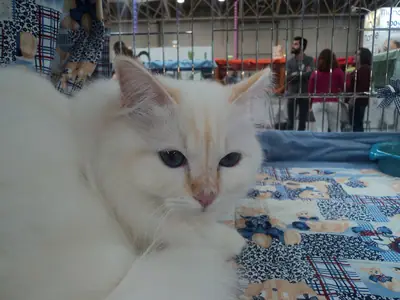
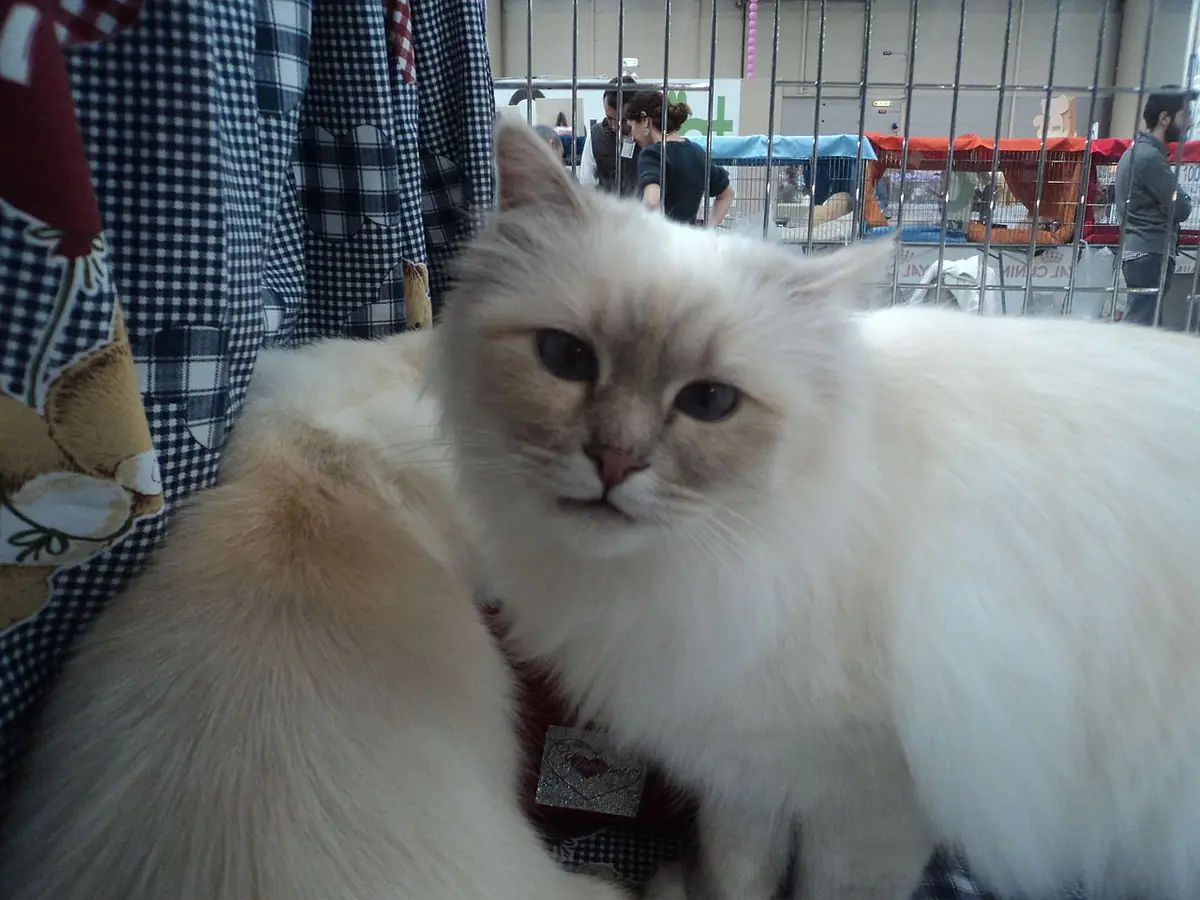
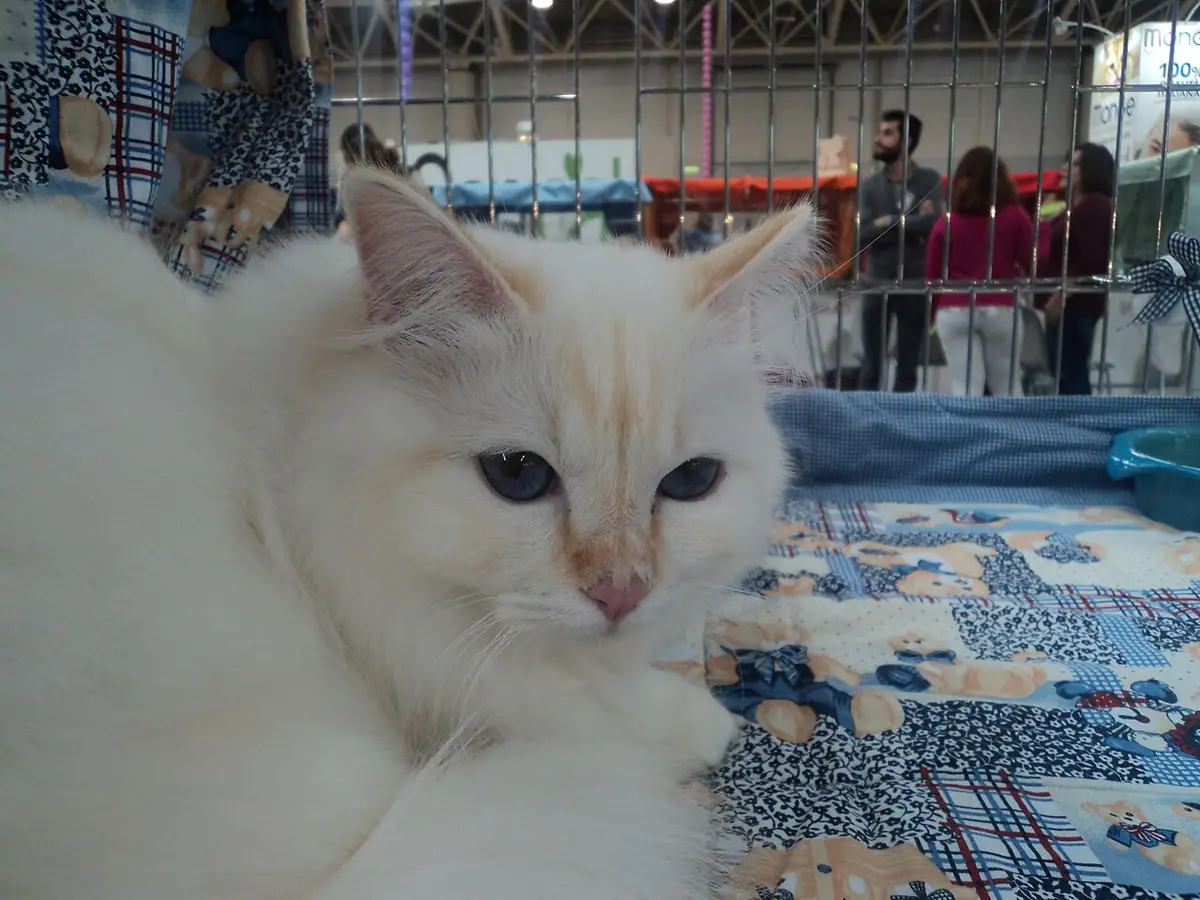
- Colours: originally only seal, blue, lilac and chocolate points; now also tabby, red, cream and tortie points [1].
- Maturity: about three years [1].
Photo gallery
7 photos · tap to enlarge- (enlarge, photo 1/7)
- (enlarge, photo 2/7)
- (enlarge, photo 3/7)
- (enlarge, photo 4/7)
- (enlarge, photo 5/7)
- (enlarge, photo 6/7)
- (enlarge, photo 7/7)
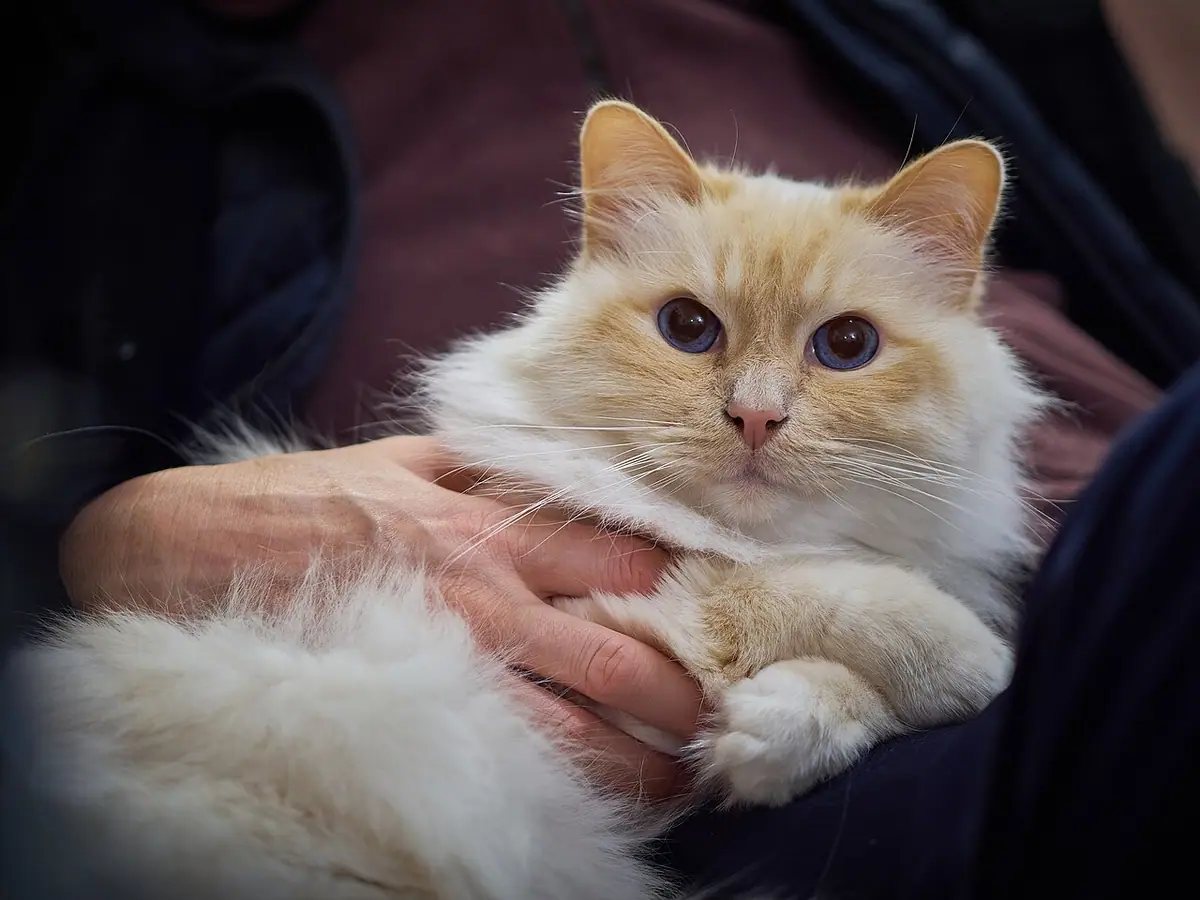
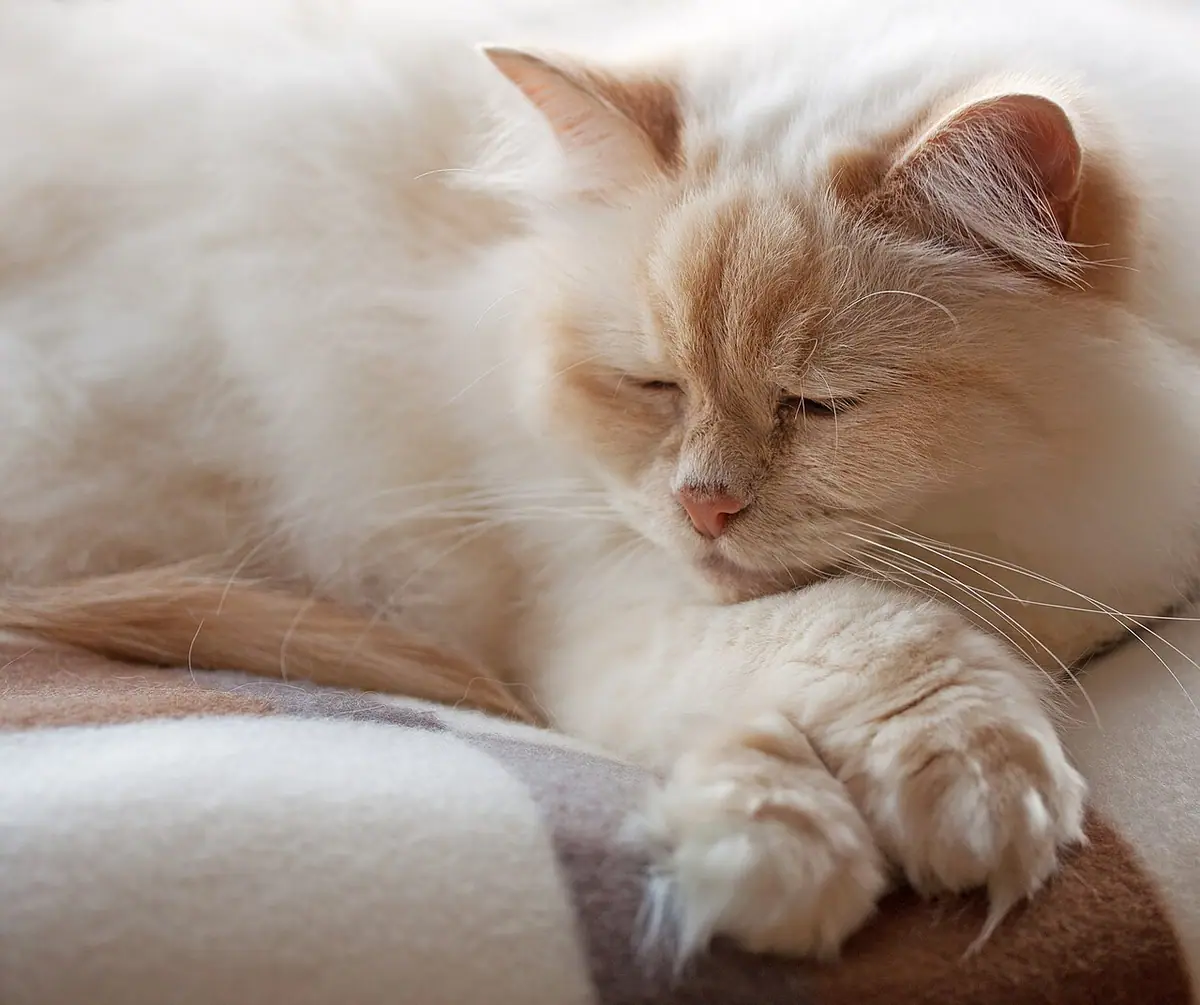

Photos: Wikimedia Commons - author & licence shown when enlarged and on the Photo credits page.
Temperament
Birmans are intelligent, enjoy learning and usually train well [1]. They're sociable, playful and like attention; moderately active, but very "helpful" with household tasks [1]. Patient and tolerant, they're an excellent choice for families with children and other pets [1]. They don't do well alone for long, so if you work away from home, consider a pair [1]. Most are soft-spoken, with chirp-like voices, though a cat whose meows always get answered may become quite a talker [1].
Care
Health
- Testing: CFA says testing for hypertrophic cardiomyopathy (HCM (Hypertrophic cardiomyopathy): A heart disease where the heart wall thickens; the most common heart disease in cats. All terms ) and other conditions has helped breeders keep a healthy, diverse gene pool [1].
- Lifespan: Median: The middle value: half the cats lived shorter than this, half lived longer. All terms 16.1 years in a UK study, but from only 12 cats, so treat it with caution [3]. A 2024 study estimated life expectancy at birth at about 14.4 years [4]. Purina UK estimates 12–16 years [10].
Ask the breeder about the parents' test results, and talk to your vet about any specific concern.
Don't confuse with…
Ask your vet. This information is for reference only and does not replace a veterinary diagnosis.
Cat facts
Frequently asked questions
Is the Birman the same as the Burmese?
No. The Birman, the "Sacred Cat of Burma", is a long-haired Colorpoint: A pale body with darker face, ears, legs and tail, like a Siamese. All terms with blue eyes and four white feet [1]. The Burmese is very short-haired, glossy, solid-coloured and gold-eyed [5].
Do Birmans shed a lot?
Less than most longhairs. With no undercoat to tangle, a weekly combing is usually enough [1].
Can a Birman be left alone?
Not for long. Birmans are very social and don't do well alone for long periods. If you work away from home and have no other pets, CFA (Cat Fanciers' Association): The world's largest registry of pedigree cats, based in the US. It keeps pedigree records, writes breed standards and runs cat shows. All terms suggests a pair [1].
Similar breeds


Breed photos: Wikimedia Commons (CC0 / CC BY / CC BY-SA) - authors & licences on the Photo credits page.
References
- CFA, Birman (breed profile & standard)
- FIFe, Breeds (SBI Sacred Birman; founding breeds 1949)
- O'Neill DG et al. (2015). Longevity and mortality of cats attending primary care veterinary practices in England. J Feline Med Surg 17(2)
- Teng KT et al. (2024). Life tables of annual life expectancy and risk factors for mortality in cats in the UK. J Feline Med Surg 26(5)
- CFA, Burmese (breed profile & standard)
- CFA, Ragdoll (breed profile & standard)
- TICA, Himalayan (breed profile)
- TICA, Browse All Breeds (Birman listed)
- GCCF, Cat Breeds (Birman breed card)
- Purina UK, Birman cat breed information
Accessed: 2026-10-02
CFA, TICA, FIFe and GCCF are the major cat registries in the US, Europe and the UK. See the glossary
Written by Catopedia from the sources above. Photos credit their author and licence under each image and on the Photo credits & licences.